The Ontario and federal governments have removed the harmonized sales tax (HST) on new homes under $1 million, and reduce the HST on new homes under $1.85 million across the province.
This article contains information relevant to the home building industry and addresses many questions that we expect our members are asking.
What was announced?
The Ontario government, in partnership with the federal government, has announced a temporary expansion of HST relief for eligible new homes in Ontario.
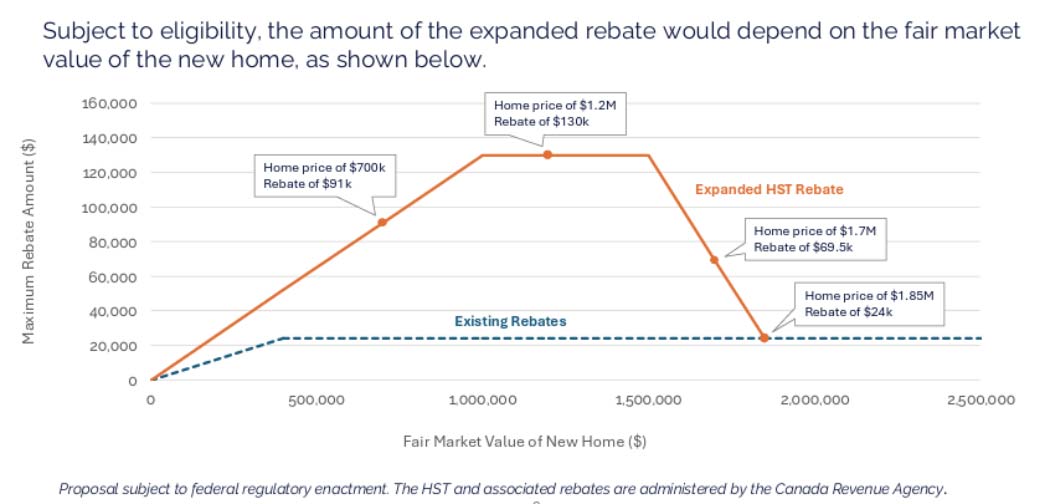
For qualifying purchases, this measure would provide up to $130,000 in HST relief, equivalent to the full 13 per cent HST on new homes valued up to $1 million. The maximum $130,000 rebate would also be maintained for homes valued between $1 million and $1.5 million, with reduced relief available for homes valued between $1.5 million and $1.85 million.
Why is this measure being introduced?
This measure is intended to improve housing affordability, help more households enter the housing market, and restore confidence in Ontario’s residential construction sector.
Supporting home purchases today is critical to restarting housing activity, protecting jobs, and ensuring that new housing supply continues to come online in the years ahead.
Reducing the tax burden on new homes is intended to:
• improve affordability for homebuyers
• help more households qualify for a mortgage
• stimulate new home purchases
• support retention of construction activity and jobs
• help ensure new housing supply continues to be built
Because housing construction operates through a pipeline in which sales lead to construction starts, improving demand for new homes helps support future housing supply.
Who is eligible?
This expanded HST relief is not limited to first-time homebuyers.
It is intended to apply to eligible purchasers of qualifying new homes, provided the home will be used as a primary place of residence or as a residential rental property, subject to program requirements.
How much could buyers save?
Eligible buyers could receive up to $130,000 in HST relief, depending on the value of the home.
The amount of relief varies by price point, with full relief available on lower-priced homes and gradually reduced relief on higher-value homes within the eligible range.
When does the measure apply?
The expanded HST relief would apply to eligible purchase agreements signed between:
April 1, 2026 and March 31, 2027.
Eligibility is based on the date the purchase agreement is signed, not the closing date, subject to program requirements and construction timelines.
What about someone who bought a home in March, before the April 1 start date?
The program applies to eligible purchase agreements signed between April 1, 2026 and March 31, 2027.
While agreements signed before April 1 would not fall within this program window, this measure creates a meaningful opportunity for households purchasing over the next year.
Because eligibility is based on the date the agreement is signed rather than the closing date, buyers who purchase after April 1 can secure the benefit even if their home closes later.
For many families, this will help bring homeownership within reach and support renewed confidence in the market.
Does a buyer need to close on the home before March 31, 2027?
No. The relevant date for eligibility is when the purchase agreement is signed, not when the home closes. However, there are additional requirements related to when construction begins and when the home is completed, which must also be met.
What are the construction timing requirements?
The government has outlined timelines that must be met for eligibility.
For homes purchased as a primary residence:
- The purchase agreement must be signed between April 1, 2026 and March 31, 2027
- Construction must begin on or before December 31, 2028
- The home must be substantially completed on or before December 31, 2031
For certain residential rental projects, different construction timing requirements may apply. More details will be provided when they become available.
Does this apply to pre-construction homes?
Yes. Because eligibility is tied to when the purchase agreement is signed, the measure is intended to apply to qualifying new homes purchased before construction is complete, including pre-construction homes, provided all program requirements are met.
Does this apply to all types of new housing?
The measure is intended to apply broadly to new housing, including newly constructed homes and homes created through substantial renovation that are treated as new for tax purposes.
This ensures the policy supports the full range of residential construction activity.
Does the measure apply to substantial renovations?
Yes. The measure is intended to include substantially renovated homes that meet the criteria to be treated as new housing for HST purposes.
Including substantial renovations ensures that the policy supports not only new construction, but also professional renovation activity across Ontario.
What is considered a substantial renovation?
A substantial renovation generally refers to a project where 90 per cent or more of the interior of an existing home is removed or replaced, such that the home is effectively rebuilt while retaining certain structural elements such as the foundation and exterior walls.
When this threshold is met, the home is treated as new for tax purposes.
Will buyers receive the rebate automatically?
Additional details on how the rebate will be administered are expected.
HST rebates are typically administered through the federal tax system, and further guidance is anticipated regarding how the expanded relief will be applied in practice.
Is this measure final?
This is a very positive step forward. The government has indicated that further details, including program implementation and eligibility specifics, will be confirmed as part of the final framework.
Why does this matter for housing supply and the economy?
Improving affordability and supporting home purchases today is essential to restoring housing market activity.
This measure is expected to help:
- Bring more buyers back into the market
- Support residential construction activity
- Protect jobs across the housing sector
- Enable the delivery of new housing supply
Ensuring that projects move forward today is critical to meeting Ontario’s long-term housing needs.
How did OHBA and BILD advocate for this measure?
OHBA and BILD have been actively advocating for tax relief on new housing as part of a broader effort to restore housing affordability and stabilize the residential construction sector.
Recent advocacy efforts have focused on:
- providing economic analysis to governments outlining the impact of the current slowdown in the housing sector and the potential benefits of tax relief on new housing
- working with industry economists and policy experts to examine how reducing housing-related taxes could support affordability and housing supply
- engaging directly with provincial and federal decision-makers to highlight the importance of reducing the tax burden on new homes
mobilizing industry members to communicate with elected representatives about the need for immediate action to support new home construction
These efforts have helped ensure that decision-makers at both levels of government understand the challenges facing the housing sector and the role that targeted tax relief can play in improving affordability.
What other policy solutions has the industry proposed to improve housing affordability?
In addition to advocating for tax relief on new housing, OHBA and BILD have also advanced broader policy discussions around the cost of building homes in Ontario.
This work has included examining the impact of development charges and other government-imposed costs on housing affordability and identifying potential approaches that could help reduce these costs over time.
The goal of these efforts is to ensure that housing policy addresses both the cost of buying a home and the cost of building one, helping to support long-term housing supply across the province.
What other initiatives are being undertaken by the industry?
OHBA and BILD are continuing to work together to support consumer confidence in the housing market and highlight the benefits of homeownership.
This includes developing a public awareness campaign aimed at reinforcing the message that now is an excellent time to buy a new home, particularly as policy changes begin to improve affordability and market conditions.
The campaign is being designed so that it can be supported by local home builders’ associations across Ontario, helping ensure the message reaches homebuyers in communities throughout the province.
Why is collaboration between industry and government important?
Addressing Ontario’s housing challenges requires collaboration between governments and the residential construction industry.
Through ongoing dialogue, research and policy engagement, industry associations help ensure that decision-makers have access to real-world data and insights about how housing policies affect affordability, construction activity and housing supply.
Working together allows governments and industry to identify practical solutions that support both homebuyers and the continued delivery of new housing.
What happens next?
Industry associations are awaiting further details of the program and will continue working with both levels of government as implementation details are finalized.
OHBA will continue to keep members informed as additional information becomes available.